We are in an exciting image with the Hamamatsu company. They create high end instruments which capture full field microsopic images. We were able to upload a sample image provided by them.
See the image on Gigapan.Org
Our philosophy has always been that we have tools for capturing images, tools for stitching images, and a website for sharing and annotating those images. We don't care if you use 'our' tools - our excitement is to provide tools for capturing, processing, and sharing gigapixel imagery!
Tuesday, June 29, 2010


Thursday, June 17, 2010
Stitching Troubles


I have taken a few focused stacked mosaics that are not stitching well for some reason using the gigapan stitcher. One is of a daisy, and the other is of the tip of a foxtail. I am going to try to figure out how to use autopano giga to stitch them and see if that works.
Monday, June 14, 2010
Ant and a Fly
The image you see here is of an ant holding a fly, taken using an optical microscope. The images is focused stacked and is a 4x6 mosaic stitched together. The image is magnified ~40x and is particularly interesting because it is a micro-gigapan of a specimen imaged last summer using a scanning electron microscope. It is neat to compare the two imaging techniques and notice the variations on what you can and cannot see through each microscope.
View the full image at GigaPan.org
This SEM image is composed of 288 images magnified around 400x.
View the full image at GigaPan.org
View the full image at GigaPan.org
This SEM image is composed of 288 images magnified around 400x.
View the full image at GigaPan.org
Thursday, June 10, 2010
Flower Power
This week I have been taking lots of micro-gigapans, both focused stacked and not, of flowers found outside my office. When I was outside I noticed that there were at least 8-10 different varieties of small flowers among the grass and was surprised by the diversity and wanted to capture it.
This gigapan was taken of a yellow flower that had been dried, the image is composed of 170 pictures taken through a table top optical microscope. The flower has been magnified ~40x. This image was not focused stacked and is 1.82 gigapixels.
View the full image at GigaPan.org
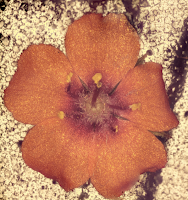
Here are two other flowers that I have imaged. The red flower is a mosaic of 24 images, each of which was focused stacked with 62 images at various focal points. This means that although the final image is only .16 gigapixels, we took a total of 1488 pictures.
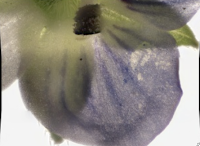
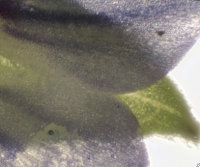
The Purple Flower was just a quick focus stacked mosaic, it is composed of far fewer images than the red flower, and the flower was magnified ~40x.
 View the full image at GigaPan.org
This gigapan was taken of a yellow flower that had been dried, the image is composed of 170 pictures taken through a table top optical microscope. The flower has been magnified ~40x. This image was not focused stacked and is 1.82 gigapixels.
View the full image at GigaPan.org
Here are two other flowers that I have imaged. The red flower is a mosaic of 24 images, each of which was focused stacked with 62 images at various focal points. This means that although the final image is only .16 gigapixels, we took a total of 1488 pictures.

The Purple Flower was just a quick focus stacked mosaic, it is composed of far fewer images than the red flower, and the flower was magnified ~40x.

 View the full image at GigaPan.org
Tuesday, June 8, 2010
"I have nothing to offer but blood, toil, tears and sweat"
This is a 35 image non-focused stacked gigapan of a drop of blood magnified ~40 and taken through a optical microscope.
View the full image at GigaPan.org
View the full image at GigaPan.org
Friday, June 4, 2010
Tails

This is a micro-gigapan of a penny, it is composed of 367 images taken through an optical microscope. This image was not focused stacked but you can explore it here:
http://gigapan.o
 rg/gigapans/50690/
The front side of the penny had been imaged previously and can be viewed here: http://gigapan.org/gigapans/41737/
A Flea
If you haven't already had the pleasure of seeing a flea, or just wanted to see one up close for once, and not crawling on your dog, this micro gigapan is for you.
This image is an initial test to see the utility of imaging flea samples using the incident light microscope. It was composed of 525 images, focus stacked with 21 images deep in a 5 x 5 array.
This flea, along with some others, was given to us by the Carnegie Mellon museum of natural history.
Tuesday, June 1, 2010
Focus stacked micro-gigapan

Here is the first focused stacked micro-gigapan. It is composed an array of 16 images, each of which is composed of 20 images that are focus stacked. 320 images were taken to make this image, which is only 0.11 gigapixels
Here is another image to compare this focus stacked gigapan to. It is a 4x4 array stitched together, but instead of using the focus a single image. As you can see it is stacked images, we instead just used not nearly as in focus as the image above.
Friday, May 28, 2010
Maker Faire 2010
Small World Explorations had an exhibit at maker faire (May 22nd-23rd) in San Mateo CA. We explained our project as well as gigapans to hundreds of people over the course of the weekend and were greeted with a lot of enthusiasm by the maker community.


Wednesday, May 12, 2010
Getting Ready to Print
Using the Gigapan gives you the freedom to select the
aspect ratio, or shape, of you your pictures.
Since you specify the top left and bottom right of your
images you can make them short and wide, tall and narrow,
or anywhere in between.
This freedom is great until it collides with the physical
world with standard size monitors and paper.
Large format printers get paper (or canvas or vinyl) on rolls,
so the fixed factor is the width.
To calculate the length you need to print a Gigapan
on a certain width paper:
Length of Paper = height of paper * gigapan width/gigapan height
Example:
I have a 91084 x 17246 Gigapan and I want to print it on 44"
wide paper. So what is the length.
length = 44" * 91084 / 17246 = 232.4" = 19 feet.
232.4" x 44" = 10,225.6 square inches = 71 square feet
There are different rates, but I've been quoted $10 per square foot
to print. That would be $710, so I probably won't be printing that
GigaPan at that size until printing costs come down!
aspect ratio, or shape, of you your pictures.
Since you specify the top left and bottom right of your
images you can make them short and wide, tall and narrow,
or anywhere in between.
This freedom is great until it collides with the physical
world with standard size monitors and paper.
Large format printers get paper (or canvas or vinyl) on rolls,
so the fixed factor is the width.
To calculate the length you need to print a Gigapan
on a certain width paper:
Length of Paper = height of paper * gigapan width/gigapan height
Example:
I have a 91084 x 17246 Gigapan and I want to print it on 44"
wide paper. So what is the length.
length = 44" * 91084 / 17246 = 232.4" = 19 feet.
232.4" x 44" = 10,225.6 square inches = 71 square feet
There are different rates, but I've been quoted $10 per square foot
to print. That would be $710, so I probably won't be printing that
GigaPan at that size until printing costs come down!
Monday, May 3, 2010
More focus stacking fun.
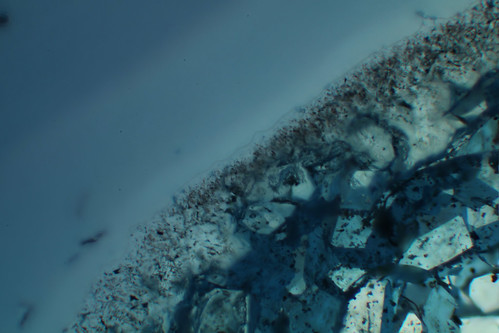
Focus stacking is fun. Here is a 32 image stack of a slice of a crystal/geode which Spencer bought at the California Academy of Sciences last year.
I've also been getting interested in fabrics, and textiles. So here is a small stack, 6 images, of a tweed weave tie dyed fabric.
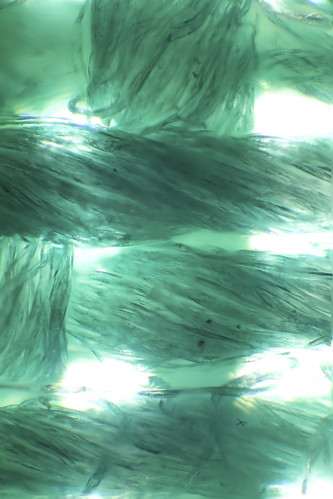
I've also been getting interested in fabrics, and textiles. So here is a small stack, 6 images, of a tweed weave tie dyed fabric.
Subscribe to:
Posts (Atom)