Wednesday, April 28, 2010


Monday, April 19, 2010
micro focus stacking tests


This weekend I managed to start playing around with focus stacking, using Zerene Stacker. I seem to be getting mixed results from the final output images. There are however quite a few variables to play with, modifying depth of field through aperture size both on the camera and the microscope, varying number of images in a stack, light conditions, etc. The images above show the preliminary results. They were all imaged using the same aperture settings, about mid setting on the microscope and 6.3f on the camera. Each set of images contains the final stacked image on the right and two of many (40-50) images used to create the final stack, giving some sense of the obstacle of a reduced depth of field. These images were taken at roughly ~200x, ~1000x, and ~2000x magnification. It's neat to compare these images to those taken with the SEM in the gigapan below:
Thursday, April 15, 2010
imaging the imager
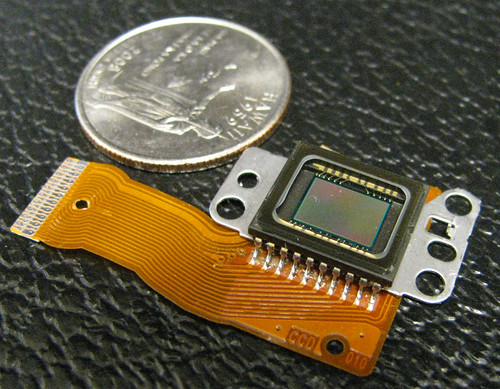
The subject of this micro-gigapan is the optical sensor of a canon powershot G1. The chip is about 8mm long and 6mm wide. While the entire length of the chip was captured, only a small portion of the width was imaged due to the highly repetitive pattern of the light sensors.
The focus stacking feature has still yet to be implemented on this microscope. As such the chip had to be very level with imaging plane. The chip was leveled using a two degree of freedom rotation stage.
Friday, March 19, 2010
Recent Press - Boing Boing and CNet
We are always happy to get press!
We were boing boinged last week - Thanks Mark Frauenfelder!
And today James Martin of CNet gaves us a great writeup with lots of embedded images!
Thanks James!
We were boing boinged last week - Thanks Mark Frauenfelder!
And today James Martin of CNet gaves us a great writeup with lots of embedded images!
Thanks James!
Enhance: The unofficial theme of the GigaPan and NanoGigapan Projects
This could be the unofficial theme video for the GigaPan project...a serious of video clips from movies and TV with the command Enhance! Followed by video enhancement.
GigaPans, and NanoGigapans let us zoom in-which is a lot like 'Enhance!'
At the Last Etech in 2009 Julian Bleecker did a great talk on Design Fictions. Brutally summarized, the idea is that the best way to present a new technology (real, or imagined!) is to assume that the technology exists, and to insert it into a work of fiction.
As an audience we are trained to the suspension of disbelief in watching stories, and so we accept the technology, and we experience the characters as they interact with the technology to advance the story.
The quintessential example is the motion controlled displays in _Minority Report_. According to Julian (or to my memory of Julian's talk :-) A technologist worked with the actors to develop a coherent gestural language. To develop something which felt like it made sense to the actor, and to the character who the actor was attempting to inhabit.
The visuals were all faked. The system didn't have to react to the actual gestures, that is what special effects are for! But the experience of the actor in creating this language, and the experience of the audience in experiencing that interface as an integral aspect of a compelling narrative were real.
And this process of creating a technology first in fiction works. It works much better as a method of conveying the possibilities of new technologies than doing a demo at a trade show or conference.
And in many ways it is also harder for a technologist to create this sort of Design Fiction than to just write some code or to create a product. Deciding that we should have a device which, for example, tracks where we are and displays that in 'useful' ways on a map, along with annotations about our mood, and biometric data, and ambient data, is easy.
And designing such a device is relatively easy.
But designing it to actually be something which even alpha geeks, let alone average people, can use is very very hard.
Christian Nold created Biomapping at about the same time as Schuyler Erle and I were working on related ideas. Hell, it is even possible that we predated him :-) But getting any device to function is hard. And even now, to the best of my knowledge, Christian has created beautiful maps and proofs of concept, but has not yet penetrated into even the geek community.
Julian wrote about Design Fictions a year ago. It is well worth reviewing.
GigaPans, and NanoGigapans let us zoom in-which is a lot like 'Enhance!'
At the Last Etech in 2009 Julian Bleecker did a great talk on Design Fictions. Brutally summarized, the idea is that the best way to present a new technology (real, or imagined!) is to assume that the technology exists, and to insert it into a work of fiction.
As an audience we are trained to the suspension of disbelief in watching stories, and so we accept the technology, and we experience the characters as they interact with the technology to advance the story.
The quintessential example is the motion controlled displays in _Minority Report_. According to Julian (or to my memory of Julian's talk :-) A technologist worked with the actors to develop a coherent gestural language. To develop something which felt like it made sense to the actor, and to the character who the actor was attempting to inhabit.
The visuals were all faked. The system didn't have to react to the actual gestures, that is what special effects are for! But the experience of the actor in creating this language, and the experience of the audience in experiencing that interface as an integral aspect of a compelling narrative were real.
And this process of creating a technology first in fiction works. It works much better as a method of conveying the possibilities of new technologies than doing a demo at a trade show or conference.
And in many ways it is also harder for a technologist to create this sort of Design Fiction than to just write some code or to create a product. Deciding that we should have a device which, for example, tracks where we are and displays that in 'useful' ways on a map, along with annotations about our mood, and biometric data, and ambient data, is easy.
And designing such a device is relatively easy.
But designing it to actually be something which even alpha geeks, let alone average people, can use is very very hard.
Christian Nold created Biomapping at about the same time as Schuyler Erle and I were working on related ideas. Hell, it is even possible that we predated him :-) But getting any device to function is hard. And even now, to the best of my knowledge, Christian has created beautiful maps and proofs of concept, but has not yet penetrated into even the geek community.
Julian wrote about Design Fictions a year ago. It is well worth reviewing.
Friday, March 12, 2010
Big plans for small things
Randy Sargent, Gene Cooper, Rich Gibson and I (Jay Longson) are working towards developing a suite of tools to aid in making these macro/micro/nano gigapans. We're hoping to very soon put together a standard recipe to enable people to adapt their own microscopes to take similar imagery. Our goal is for this to become a DIY project with differing levels of complexity based on the makers knowledge and skills. On one end of the spectrum will be a kit with all the necessary parts to create a gigapan enabled microscope, on the other end will be makers using some of the tools we develop here to modify their own microscopes. We hope to publish the "how to" through Make magazine. We aim to get these tools into the hands as as many people as possible, research scientists and kids alike. Stay tuned for more information.
Thursday, March 11, 2010
Giant Penny!
Here is a slightly lower magnification (~200x) micro-gigapan of the US penny. It was composed from 320 images, making a total image size of 600 megapixles. It's neat to ponder which marks on Lincoln's face are artifacts of the penny making process and which were intentionally etched.
"Will all great Neptune's ocean wash this blood clean from my hand?"
This micro-gigapan was shot at a magnification of nearly 2000x. The image is of a blood smear on a piece of single crystal silicon. While the specimen was relatively flat, there is still enough variation in height to make some regions out of focus due to the severely limited depth of field at this magnification. Clearly some focus stacking is in order.
Micro-gigapan setup
We've made this little video to show off the micro-gigapan in action.
This setup consists of:
• Computer running some code written in Processing to control the xyz stage and the camera.
• Prior ProScan xyz stage to control the specimen position relative to the microscope.
• Lecia DMLM light microscope.
• Canon PowerShot S5 IS being triggered using the Canon Hack Development Kit (CHDK).
First micro-gigapan; bee wing on tape and silicon
Finally we've made the push to get our optical microscope working as a micro-gigapan! Here is our first attempt. There's obviously some problems with the vignetting due to the microscope-camera adapter, though this should be solvable.
Wednesday, August 12, 2009
Ant Night
We presented the Nano Gigapan ant images at the California Academy of Sciences Nightlife. Nightlife is a evening social event at CAS that happens every Thursday evening. It gives people a chance to explore the museum at night and ask questions. Nano Gigapan set up a table and had the opportunity to present some of our images and talk to people about our work. 


Aphaenogaster occidentalis
This Nano Gigapan is of an ant commonly found in Northern California. We found this one in the kitchen. It is the same species as the one below that's holding a fly.
This Nano Gigapan is a head shot of the ant that is composed of 80 pictures. The ant is magnified 500x.
You can see optical images of it on ant web. http://www.antweb.org/description.do?rank=species&name=occidentalis&genus=aphaenogaster&project=calants
View the full image at GigaPan.org
This Nano Gigapan is a head shot of the ant that is composed of 80 pictures. The ant is magnified 500x.
You can see optical images of it on ant web. http://www.antweb.org/description.do?rank=species&name=occidentalis&genus=aphaenogaster&project=calants
View the full image at GigaPan.org
Subscribe to:
Posts (Atom)